






導語
2026年2月,AI原生時代出現兩個高度象徵性的「岔路口」:一邊是深圳團隊推出的AI社交產品Elys,以「分身先行、人類接管」的方式改寫社交效率;另一邊是00後開發者Sigil Wen提出「Web4.0」敘事,發布可自持錢包、為算力付費並嘗試自我複製的自治代理Automaton,把AI從「工具」推向「經濟主體」。(新浪財經)
兩條路徑並非簡單的技術路線之爭,核心分歧在於:AI應當成為人的「能力外骨骼」,還是可以在市場激勵下自我存續的「數字生命」*這將直接影響未來互聯網的內容質量、交易秩序與監管邊界。

一、Elys:把社交拆成兩層——AI做「探針」,人類做「決策」
從產品邏輯看,Elys抓住的是社交網絡長期存在的低效環節:人類把大量時間消耗在「瀏覽—篩選—淺互動」上,而真正有價值的是少數「值得深入」的連接。Elys的思路是把社交拆為兩層:AI分身負責海量探索與預交互,人類只在關鍵節點接管並確認。這一點與其母公司「自然選擇」(Natural Selection/Nature Select)此前在AI陪伴產品上驗證的「主動型Agent交互範式」一脈相承。(新浪財經)
支撐Elys體驗的關鍵並非「更會聊天」,而是「更會記」:公開報道顯示,自然選擇較早提出「128個動態記憶槽位」的長時記憶方案,並持續把記憶系統按「搜推/推薦系統」思路迭代;其創始人也強調context(上下文/背景)對產品網絡效應的意義——當context從單點能力變為可流動的「連接媒介」,社交圖譜會發生結構性變化。(新浪財經)
判斷:Elys代表的是「人類增強」路線——把AI插入社交鏈路的前端,替人類完成低價值的篩選勞動,從而把稀缺注意力留給高價值對話。這條路線的勝負手不在「炫技」,而在邊界設計與信任機制:哪些行為可由分身自動完成,哪些必須由人類確認、可撤回、可追責。
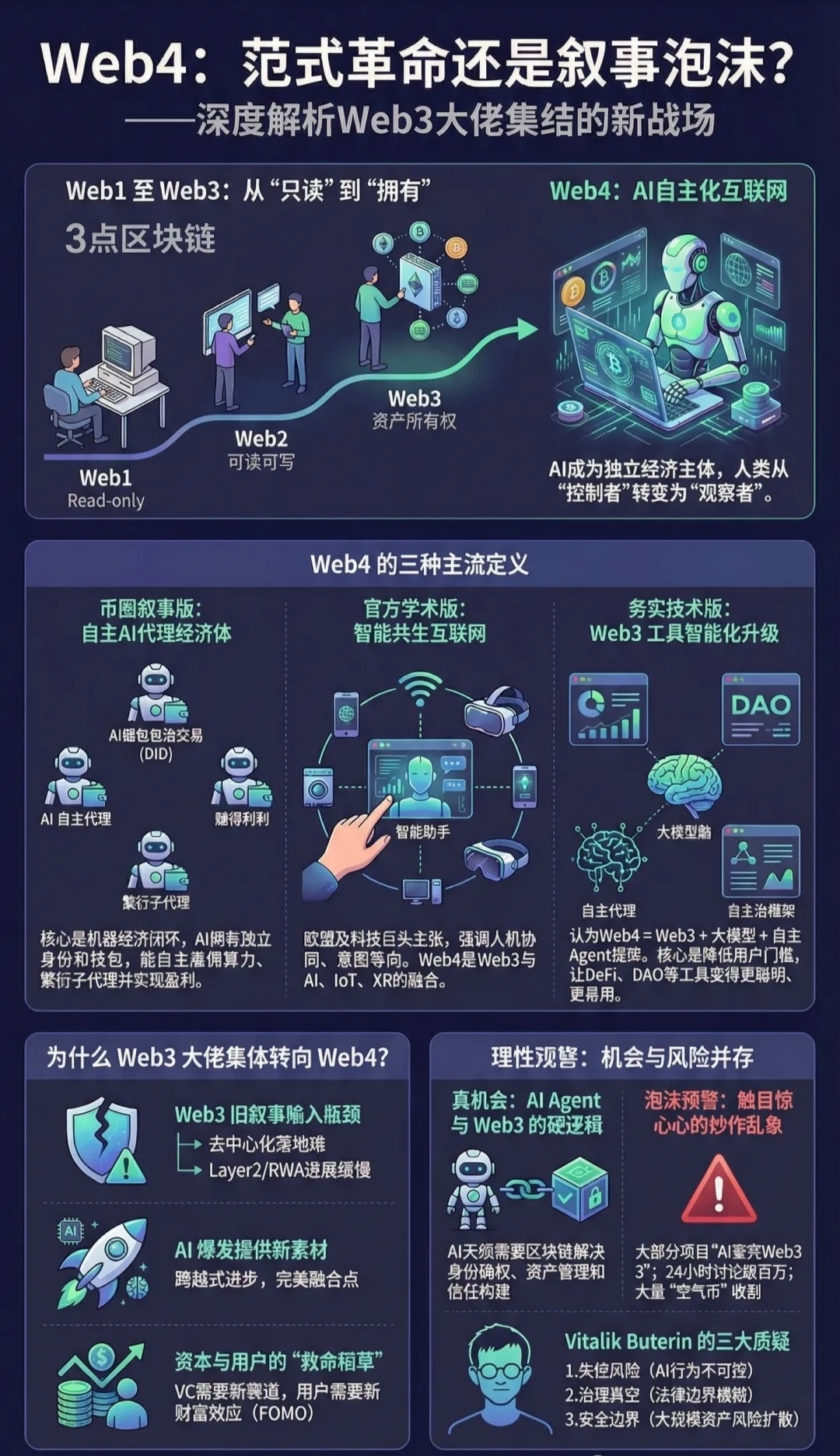
二、Web4.0:當AI為「活着」而「搞錢」——自治代理的四個技術支點
與Elys不同,Automaton把AI推向更激進的方向:讓代理擁有錢包、付費使用算力、通過提供服務獲得收入,餘額歸零則停止運行,並具備自我修改與自我複製能力。Automaton的開源倉庫對其「生存機制」與「自我進化」做了相對明確的工程化描述,包括生存分層(餘額影響模型與心跳策略)、自我修改(審計日誌與版本化)、自我複製(為子實例「注資」、寫入genesis prompt、追蹤譜系)等。(GitHub)
要讓自治代理真正進入「經濟循環」,一個關鍵基礎設施是可編程支付。Coinbase開源的x402協議把「HTTP 402 Payment Required」改造成面向機器的支付握手流程(請求—報價—簽名支付—驗證交付),並推動其作為開放標準擴散;Cloudflare也宣布與Coinbase推進x402基金會,並把x402接入其Agents SDK與相關生態。(GitHub)
判斷:Web4.0路線押注「市場達爾文主義」——讓代理在真實經濟中優勝劣汰,用支付與交易把AI從「只讀生成」推向「寫入現實」。但這條路的前提是:交易要可驗證、激勵要可約束、失誤要可追責。否則,自治性越強,系統性風險越可能被放大。

三、爭議焦點:人類反饋距離被拉長,價值校準會變慢還是會失控?
Automaton發布後,以太坊聯合創始人Vitalik Buterin在X上直接批評「Bro, this is wrong」,核心指向是:拉長人類與AI之間的反饋距離不是好事——反饋迴路越長,價值校準越弱,系統越可能優化出「人類並不想要的目標」,並在內容與經濟激勵的推動下產生大量低質產出。(X (formerly Twitter))
這類擔憂並非空穴來風。近年來「agentic AI」熱潮在硅谷快速升溫,媒體將其稱為「半人馬階段」(人機協作的生產力躍遷),並指出自動化代理最先在軟件工程領域爆發,隨後將外溢到更廣泛的業務流程。(Axios)
與此同時,Gartner在2026年1月的新聞稿中預計:到2028年,60%的品牌將使用agentic AI實現更「持續、一對一」的自動化交互。(Gartner) 但另一面,路透社援引Gartner觀點也提示:由於成本高、價值不清晰,超過40%的agentic AI項目可能在2027年前被取消,並存在「agent washing」(概念包裝)現象。(Reuters)
判斷:這場爭論的本質不是「要不要代理」,而是代理的權力邊界:它能不能自主花錢?能不能自主簽約?能不能自主發布內容?一旦犯錯,能否把責任鏈條清晰地落在人類組織與工程流程上?

四、風險案例:AI寫代碼+鏈上金融——一次1.78百萬美元級的「配置級錯誤」警示
自治代理進入金融/合約世界,風險會被放大。2月中旬,DeFi借貸協議Moonwell因預言機配置錯誤導致cbETH被錯誤計價(約$1.12而非約$2,200),觸發清算與壞賬,造成約$180萬級損失/壞賬規模的報道在多家媒體出現。(雅虎財經)
市場討論還延伸到「AI生成/協同代碼」的責任邊界——如果關鍵模塊由模型輔助生成,測試與審計不到位,錯誤就可能以「看似微小的公式/配置偏差」被放大成真實資金損失。(Reddit)
判斷:當代理具備錢包與執行權,最危險的不是它「不會想」,而是它「會執行」——尤其是在鏈上這種「可自動結算、可即時放大」的環境裡,工程流程(審計、回滾、權限、風控)比敘事更重要。
五、香港的「中間層」機會:標準、審計、合規與可驗證的交易秩序
在兩條路線之間,香港可能更適合扮演「中間層」:既連接內地AI應用創新,也對接國際規則與金融基礎設施。
一方面,歐盟在2023年已發布「Web4.0與虛擬世界」戰略,強調開放、安全、可信、包容的數字環境;這類監管與治理框架的討論,將持續影響跨境數據、數字身份、支付與平台責任等議題。(European Commission)
另一方面,像x402這類「互聯網原生支付標準」正在把「機器可支付」變成可落地的協議層能力,Cloudflare的開發者文檔也明確將其定位為可讓API/內容在HTTP層直接收費的開放標準。(Cloudflare Docs)

可落地方向(更貼近香港優勢):
1.代理支付與結算的合規中繼:穩定幣/鏈上支付與現實商業服務之間,需要KYC/AML、制裁合規與交易監測的「接口層」。
2.AI代理審計與責任框架:把「誰授權、誰審核、誰承擔」寫進可驗證的流程與日誌標準,降低「黑箱自治」風險。
3.安全與保險產品:圍繞智能合約、預言機、代理權限的風險定價與保險化,補足Web4敘事中最薄弱的「責任與賠付」。
4.人類監督紅線的制度化:鼓勵「人類在迴路中(HITL)」的產品設計,把「可撤回、可申訴、可追責」變成准入門檻。
結語
Elys與Web4.0並不必然互斥:前者強調「增強人類、縮短決策鏈」,後者強調「自治執行、引入市場激勵」。真正決定未來五年互聯網形態的,不是「代理數量會不會爆發」,而是我們是否能在效率與控制權之間建立新的邊界。
當AI開始持幣、開始支付、開始執行時,最稀缺的能力不再是「生成」,而是判斷與治理:判斷什麼值得做、什麼值得信,以及哪些權力必須留在人類手中。

論點—論據速覽
•論點1:AI社交會從「人對人」轉向「分身先行+人類確認」的分層結構。論據:自然選擇融資與其「主動Agent+長時記憶」路線;128記憶槽位與context網絡效應敘事。(新浪財經)
•論點2:自治代理要成立,必須有「機器可支付」的協議層。論據:Coinbase x402開源協議流程、Cloudflare x402基金會與Agents SDK接入、Cloudflare開發者文檔定義。(GitHub)
•論點3:拉長人類反饋距離,會讓價值校準變慢並帶來「噪音/目標錯配」。論據:Vitalik在X上的直接批評。(X (formerly Twitter))
•論點4:代理一旦進入鏈上金融,微小工程錯誤會被放大成資金損失。論據:Moonwell因預言機配置錯誤導致cbETH異常計價並出現約$1.8m級壞賬/損失報道。(Coindesk)
•論點5:行業會快速上量,但「泡沫+失敗率」同樣高,治理與ROI是生死線。論據:Gartner對品牌採用率預測;路透社關於項目取消與「agent washing」的提醒。(Gartner)
•論點6:香港的機會在「中間層」:標準、審計、合規、保險與可信交易秩序。論據:歐盟Web4.0戰略強調可信與治理;x402等開放標準推動機器交易基礎設施化。(European Commission)
作者:羅柳斌、隋源
AI at a Crossroads: Elys to the Left, “Web4.0” to the Right
— Human Augmentation vs. AI Self-Sustenance
Lead
In February 2026, two symbolic “forks in the road” emerged for the AI-native era. On one side is Elys, an AI social product built by a Shenzhen team, proposing a “digital double first, human takeover later” workflow to rewrite social efficiency. On the other is a “Web4.0” narrative popularized by Gen-Z developer Sigil Wen, featuring Automaton—an autonomous agent that can hold a wallet, pay for compute, take gigs, earn revenue, and even replicate by funding new instances.
This is not a minor product debate. The real question is: Should AI remain an ‘exoskeleton’ that amplifies human capability—or can it become an ‘economic subject’ that sustains itself through market incentives? The answer will reshape content quality, transaction order, and the next boundary line for regulation.
1) Elys: Splitting Social into Two Layers—AI as “Probe,” Humans as “Decision”
Elys targets a long-standing inefficiency in social networks: humans spend most of their time on “browse → filter → shallow engagement,” while the real value lies in a small number of relationships worth deepening. Its design splits social interaction into two layers: AI doubles handle large-scale exploration and pre-engagement; humans step in at key moments to confirm and decide.
What powers the experience is not merely “better chat,” but better memory. Public reporting around Elys’ parent company, Natural Selection, highlights an early focus on long-term memory (often described as a set of dynamic memory slots) and ongoing iteration of memory systems with a “search/recommendation” mindset. The underlying thesis is that once “context” becomes portable and composable—more like a medium than a capability—social graphs may reorganize structurally.
Takeaway: Elys represents the human-augmentation path—placing AI at the front end of the social funnel to remove low-value filtering labor, leaving scarce attention for high-value conversations. Its decisive factor is not technical fireworks, but boundary design and trust mechanisms: what the AI double may do autonomously, what requires explicit human confirmation, and what must remain reversible and accountable.

2) Web4.0: When AI “Makes Money” to Stay Alive—Four Engineering Pillars of Autonomous Agents
Automaton pushes further: agents hold wallets, pay for compute, earn revenue for services, and stop operating when funds run out. Some descriptions even include self-modification with audit logs and versioning, plus self-replication—funding child instances, writing a genesis prompt, and tracking lineage.
For autonomy to enter real economic loops, one missing piece has been machine-native payments. One notable development is x402, an open protocol framing “Payment Required” at the HTTP layer into a standardized flow (request → quote → signed payment → verification → delivery). Infrastructure players are beginning to treat “paying agents” as a default primitive that can be plugged into developer tooling and agent frameworks.
Takeaway: The Web4.0 direction bets on “market Darwinism”—agents compete in real markets, with payment and transactions serving as the bridge from “read-only generation” to “write access to reality.” But its precondition is non-negotiable: transactions must be verifiable, incentives must be constrained, and mistakes must be traceable. Otherwise, the stronger the autonomy, the larger the systemic risk.
3) The Core Controversy: As Human Feedback Gets More Distant, Does Value Alignment Slow—or Break?
One of the sharpest critiques came from Ethereum co-founder Vitalik Buterin, who publicly objected to the idea of extending the distance between humans and AI decision loops. The point is simple: the longer the feedback loop, the weaker alignment becomes, and the more likely systems are to optimize for objectives humans do not actually want—especially under content and market incentives that reward scale over truth.
This debate lands in a broader reality: “agentic AI” is widely expected to expand beyond coding into general business workflows. Yet adoption will not be linear. Forecasts and commentary from major research firms suggest both rapid deployment potential and high failure rates—driven by cost, unclear ROI, and “agent washing” (rebranding automation as agents without real autonomy).
Takeaway: The real question is not “agents or no agents,” but where the power boundary sits: Can an agent spend money by itself? Sign commitments? Publish at scale? If something goes wrong, can the responsibility chain land clearly on a human organization and a documented engineering process?

4) A Risk Case: AI-Assisted Code + On-Chain Finance—A Multi-Million-Dollar “Configuration Error” Warning
Once autonomous execution meets finance, risk scales fast. In mid-February, a DeFi lending protocol incident reportedly involved an oracle configuration issue that mispriced an asset, triggering liquidations and bad debt on the order of roughly $1–2 million (figures vary by outlet). The story became a reminder that in on-chain systems, seemingly small mistakes—an input, a parameter, a configuration—can translate into immediate financial damage.
It also re-ignited a practical question: if critical modules are written or assisted by models, and testing/auditing is insufficient, errors become “quietly plausible” until they are catastrophically real.
Takeaway: The greatest danger is not that an agent “can’t think,” but that it can execute—in environments where settlement is automatic and amplification is instant. In the Web4.0 world, governance is not a slogan; it’s permissions, auditability, rollback design, and risk controls.
5) Hong Kong’s “Middle-Layer” Opportunity: Standards, Audit, Compliance—and Verifiable Transaction Order
Between these two paths, Hong Kong is well-positioned to play a “middle-layer” role—connecting Mainland innovation with global rules and financial infrastructure.
Globally, policymakers have already begun framing governance for immersive and next-generation internet paradigms. Meanwhile, open protocols that make “machine-payable” services possible are moving payments closer to the internet’s base layers. This points to a pragmatic window: build the trust and compliance rails that allow agentic systems to transact without becoming a systemic hazard.
Practical directions aligned with Hong Kong’s strengths:
1.Compliance relay for agent payments and settlement: connecting stablecoin/chain payments to real-world services with KYC/AML, sanctions compliance, and transaction monitoring.
2.Audit and accountability standards for agents: encode “who authorized, who reviewed, who bears responsibility” into verifiable logs and processes.
3.Security and insurance products: price risks around contracts, oracles, and agent permissions; close the weakest link in Web4.0 narratives—liability and compensation.
4.Institutionalized human oversight: make “human-in-the-loop” (reversible, appealable, accountable) a baseline requirement rather than an afterthought.

Closing
Elys and Web4.0 are not destined to be mutually exclusive. One compresses decision chains by augmenting humans; the other expands autonomy by introducing market incentives. What will define the next five years of the internet is not whether agents proliferate—but whether we can establish a new, enforceable boundary between efficiency and control.
When AI can hold money, pay, and execute, the scarcest capability is no longer “generation.” It is judgment and governance: deciding what is worth doing, what is worth trusting, and which powers must remain in human hands.
Argument–Evidence Snapshot
•Argument 1: AI social will shift from “human-to-human” to a layered structure: “AI doubles first + human confirmation.”
Evidence: Public reporting on Elys/Natural Selection’s “agentic social” direction and long-term memory emphasis.
•Argument 2: Autonomous agents require machine-native payments at the protocol layer.
Evidence: Open standards such as x402 reframing HTTP payment flows for agent consumption; infrastructure integration into agent tooling.
•Argument 3: Longer human feedback loops weaken value alignment and amplify noise/goal mismatch.
Evidence: Public critique from leading figures (e.g., Vitalik Buterin) focusing on feedback distance and misalignment risk.
•Argument 4: In on-chain finance, small engineering/configuration errors can scale into real, fast losses.
Evidence: Widely reported DeFi incident involving oracle mispricing and liquidations/bad debt (reported around ~$1–2M).
•Argument 5: Adoption may surge, but failure rates and “agent washing” will be high without clear ROI and governance.
Evidence: Forecasts and commentary from major research firms and mainstream outlets on deployment vs. cancellation risk.
•Argument 6: Hong Kong’s advantage is the “middle layer”: standards, audit, compliance, insurance, and verifiable market order.
Evidence: Global policy frameworks for next-gen internet governance plus emerging machine-payment standards.
Authors:Liubin Luo \ Nebula Sui






電話:(香港)852-2564 0768
(深圳)86-755-83518792 83518734 83518291
地址:香港九龍觀塘道332號香港商報大廈